
Graham's Blog

Revista Revisited … Valencia’s chain of command

Revista De La Liga may be in the can for another week, but this is an opportunity to push Graham into extra-time.
In the second part of ‘post-match Revista’, he reflects on the burgeoning career of young Scot Ian Cathro, currently the assistant to Nuno Espírito Santo at Valencia, who was interviewed by Sky’s Charles Paterson for this week’s show.

Ian Cathro is a 28-year-old Scot who has never played professional football but is the assistant manager at Valencia. Is this the right club at which to advance his career?

Ian is there because of Nuno. Nuno is there because of Jorge Mendes. Jorge Mendes is there because of Peter Lim. There’s a hierarchy which means that he is not just a 28-year-old Scot who is learning Spanish from Portuguese. There is a clear line of importance from manager’s consigliere, part of the personal regime of Jorge Mendes – the world’s most important football agent, who has been Peter Lim’s consigliere as he tries to buy the club. Although the documents aren’t signed yet, it’s close.

There’s been a healthy sprinkling of footballers who have been brought in – and are as new as Ian, and therefore not sitting at the Mestalla saying ‘show us your medals’ and all that kind of rubbish. Those new players owe their presence at Valencia to Nuno, Peter Lim, Mendes or a combination of all of them. And, therefore, Ian Cathro – talent aside – is an extension of the regime and, as such, there is a collegiate feel to it. It’s far less hierarchical or sniffy, and that is a platform in which I expect somebody of talent to be able to express himself.

Nuno is very much a frontline, on-the-training-ground guy. His man-management, his ability to inspire people, is probably his biggest calling card. That, rather than the way in which Paul Clement at Real Madrid has been asked to take sessions so that Ancelotti can observe, is what gives Ian Cathro more room to be the guy giving wise words to Nuno: ‘This player’s on form, this player needs to be taught this or that’. His input is probably more vital at this stage to the manager than maybe his one-on-one work with the players. That’s my impression, but it is one that I hope to sharpen by going down and meeting the pair of them.

It’s potentially the right place for a young Scot who hasn’t been a professional footballer. However, it is a very, very critical environment. Valencia’s fans absolutely believe that they should be winning the league and should be competitive in Europe. Over the generations, they have been fed, with that. We can speak progressively and optimistically now because the displays are there, the results are there. If that were to turn over the course of five or six games then they would all find it a more testing ride. But, at the moment, there is a crest-of-the-wave feeling which goes beyond the fact that they have been recording relatively positive results.
Revista Revisited … the Casillas question

With another episode of Revista De La Liga in the can, this is an opportunity for Graham to expand on some of the issues discussed in the bar.
In the company of Scott Minto, Guillem Balague and Terry Gibson, he reflected on the possible dropping of Iker Casillas and the impact of Ivan Rakitic at Barcelona.
Here we dig a little deeper into those two issues.

There was lively discussion in the Revista bar about the report in Spanish newspaper Marca that Iker Casillas may be dropped for the Elche game tomorrow [Tuesday] night. So long as Marca’s story is correct, is it the right call by Carlo Ancelotti to drop his No.1 goalkeeper?

I’ve got a particular allegiance to Casillas not because of friendship or experiences shared, but because he has always been an idiosyncratic goalkeeper who represents something from a slightly different age. One of the reasons he didn’t fit with Mourinho is that Mourinho believes the more detailed and scientific your preparation, the more likely you are to succeed. And his record shows there is a lot in that.
If I saw a player beginning now the way Iker has constructed his career, it’s likely that I would be saying ‘You can become more mechanical, more invested in the percentage actions coming off for you’. But he’s got where he’s got to based on very hard work, very great talent, but something else that comes up in the Spain book…
Back at Euro 2008, Jose Manuel Ochotorena, the Spain goalkeeping coach, made it clear that they had all the information to tell Iker what he needed to know about the Italian penalty takers [in the quarter-final, which Spain won 4-2]. And Iker said ‘No, leave me’. Ochotorena walked away knowing that Iker had to go into his zone. He thrives on instinct. He has become San Iker – Saint Iker – because of going into a zone in moments of high pressure; something innate comes out.
That innate part of Iker Casillas has been chipped away at so much over 50-plus league weeks out under Mourinho and Ancelotti, plus the jeering from fans he thought should be devoted to him, then the enormous psychological and spiritual cost of winning La Decima last season then the humiliation of the World Cup. If you base yourself on planning, science and technique, then you have things to fall back on that are not simply ‘do you feel well in yourself’.
Right now, if you look at Casillas’ form, this season he has been mostly faultless for the goals that Real have conceded. Sir Alex Ferguson made decisions in his career which were strategic, soaked with years of experience and included risk. At the end of it, when he had won the trophies to prove he was the best, he identified that taking the decisions that others were scared of was fundamental to him.
If Marca are right and Iker is to be dropped, then while I will remain an Iker supporter and sympathetic to what has happened to him and the way in which he has been undermined, I will certainly understand that Ancelotti is trying to lance a problem at a time when his team have scored 13 goals in two games; that has given him the breathing space to look analytically and say ‘We’ve won the last two. I can argue that Iker is not being blamed but I’m going to take a brave, big decision’. For that reason, IF Ancelotti goes ahead with [dropping Casillas], I’ll be more supportive and more analytically appreciative of it than I would have been otherwise.

We talked about the positive impact Ivan Rakitic has had on Sergio Busquets, but how big an influence has the Croatian been in helping Barca recapture something of the high-tempo, hungry elements which defined the start of Pep Guardiola’s reign at the club?

Xavi said that the atmosphere, work ethic and ‘feeling’ reminded him of the beginning of the Pep era. I think it’s been reported as him saying ‘the team is playing Pep style football’, but it was more like an old-fashioned weatherman sniffing the air and saying ‘it smells like rain’. I think that is your first marker that things are tighter, healthier, more focused, intense and unified.
I would argue that across the span of the Pep years, if we are comparing the very early months of Luis Enrique, the span began in a pretty blue-collar manner. The treble, exciting as it was, was a very gritty year. They played lovely football but it was based upon some wins which were pretty gnarly – the win away at Donetsk, the 3-2 win against Betis, the bare-knuckle 2-0 Clasico win, the 3-3 draw with Villarreal towards the end of the season when Iniesta gets injured, then hauling themselves back into it in the last seconds against Chelsea – there was just a sleeves-rolled-up, everybody-in-it-together element which I think doesn’t compare to the football apogee of the Pep years, which would probably be the 2011 final and the World Club final against Santos.
That arc began with blood, sweat and tears and I think what we are seeing across the board now is an influx of new blood, new enthusiasm, players who are thrilled to be at Barcelona. I look at Vermaelen’s work to get fit, I look at Sandro, Munir, Mathieu and undoubtedly Rakitic, and you see guys who would have given anything to be bought by Barcelona and paid massive money to be there.
In terms of the work ethic, there’s an important connection [between the two eras] in the manner of making every second of the working day count. Luis Enrique has re-instituted the breakfasting together at the training ground, the absolute intensity of every minute in training – there’s a correlation between that and this group of players separating themselves from the other blue-collar teams in La Liga who want to frustrate, stifle and outwork them.
Rakitic embodies all that is good. He looks like he can’t believe his luck. He spoke at length about having turned other teams down and that would have included Real Madrid; the brand of football is exactly what he lives for, but there is his willingness to be defensive, to be the pivote, to allow Busquets time to push forward.
[Against Levante], when he clears the ball from the back-post area with a brilliant, saving tackle, if you look at him as he is racing back, he has taken a little look over his shoulder to see where the Levante player is rather than just focusing on the ball and how he is going to clear it. That’s the run that Busquets would have had to make over the last two seasons. Exceptional though he is, Busquets is not as quick as Rakitic. There will come a stage in the season when Barcelona will have to rotate Rakitic – as they did in midweek against Apoel – because of the amount of ground he is covering.
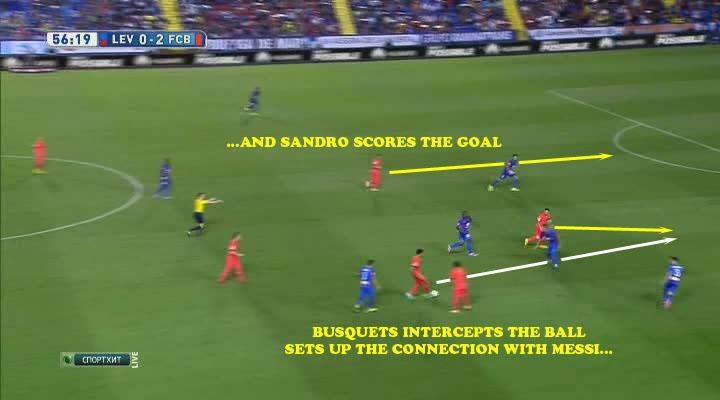
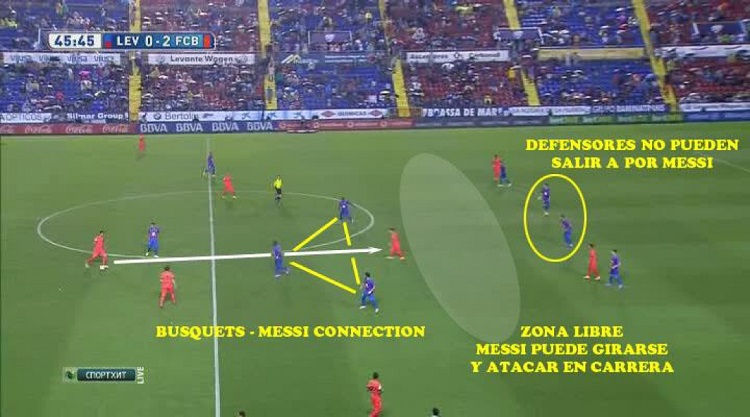
In the Athletic game, there is a fabulous Busquets pass to Messi, who then passes to Neymar to open the scoring. That’s Busquets in an advanced position playing a first-time ball. [Against Levante], Busquets plays in Messi for Sandro’s goal (see below). These are the types of exquisite jobs he was able to do less and less because of, not simply having to cover for Xavi who was letting players go past him because he couldn’t get back, but mentally his concentration had to be ‘what’s happening to my right-hand side?’. He already knows he doesn’t have to be like that and it has been liberating in terms of his interceptions, one-twos and his creative use of the ball going forward. That’s why I’m convinced we are getting the most efficient and enjoyable version of Busquets we’ve seen for maybe three years.

Images are the copyright of BarcaLogia (@barcalogia)

busi

busi1


Luis Enrique: The Bench Whisperer

Details, details.

February 22, 2014. Real Sociedad 3-1 Barcelona

La Real lead reigning champions Barcelona 3-1 – from the 58th minute. There are 32 minutes plus added time left, his team look over-run, but Gerardo Martino chooses not to use all three substitutes. He ignores the claims of Xavi, Tello, Dani Alves or Mascherano to add anything, anything at all to the task of not losing.

April 12, 2014. Granada 1-0 Barcelona

It’s a defeat which leaves Martino’s team third, and four points behind leaders Atlético Madrid. They trail to Yacine Brahimi’s 16th-minute goal. There remain 74 minutes plus added time to reverse a scoreline which helps cost them the title. But the Argentinian, again, only uses two subs, ignoring completely the chance that Sergi Roberto, Xavi, Tello or Alves might influence the match. These are just two examples of Martino, eventually, proving either too eccentric or inadequate for what this behemoth club needed at the helm.  Bizarre beyond belief.

NB Barcelona lose the title by only three points

September 21, 2014. Levante 0-5 Barcelona.

Luis Enrique continues his remarkable record. He’s the bench whisperer.

First league game, Elche at home.  Mascherano is sent off, the coach takes a long look at the situation. He takes off Rafinha, a former pupil of his at Celta Vigo and far more experienced than the young debutant he leaves on the pitch – Munir.  Bartra comes on to shore up the back. Almost immediately after half-time the coach’s bet pays off. Munir scores a sublime, left-footed half-volley. Barcelona go 2-0 up and cruise to a win.

Second league game, Villarreal away. The yellows park several submarines. Neymar comes on first, Sandro next, then Xavi. Neymar releases Messi into the box with moments left, Messi squirms a shot under keeper Asenjo and another sub, Sandro, tucks it in. Xavi helps control the game and see it out.

Third league game, Athletic Club at home. Piqué and Neymar are left on the bench – more messages from the new coach. ‘I decide’. Status, big price tag, media pressure – all these things mean nothing to Lucho. A player is fit, focused and in form. Or he doesn’t play. Both come on and respond to the challenge. Neymar, fresh and quick when the game is stretched, scores twice. Oh, and the other sub, Sandro, comes on and in less than 60 seconds presses Laporte into giving the ball away for what will become Barcelona’s opening goal in a match which had been razor-clam tight.

Fourth league game, Levante away. Earlier tonight. Neymar twists the ankle which has already seen him limp out of the Camp Nou on Tuesday, after the 1-0 win over APOEL. Doctor Pruna nearly has to drag him off the side of the pitch because the Brazilian can smell more goals to add to his assist from Messi … but common sense prevails. Luis Enrique doesn’t send on boy wonder Munir, who’s started every game thus far in the season. He puts on Sandro again. Who adds another goal.

The power of knowing your squad well. The power of ensuring that they not only work hard but are constantly intense, focused – up for it. The power of working so hard at your job that you totally understand their form, their strengths and weaknesses … the challenge of the opposition.

At the moment, Luis Enrique is right in the zone. The harder he works, the more that comes off for him. When a squad of this talent has a coach working himself, and them, this well, then intensely good things happen.

As for Tata? Inexplicable. Just inexplicable.

Sid and I: La Liga Live, part two

Here’s part two of my recent event with Sid Lowe, at the Manchester Football Writing Festival.
Thanks to Waterstones Deansgate, and Matt Gardiner in particular, for putting the festival on, and to St Anne’s church in Deansgate for allowing us to use their unique venue to talk about football with a super-smart crowd.
See you at the next one.

You can listen to part one here.

GH

SidandGraham

From Eto’o, with love: Kaptoum and Enguene shine for Barça

FC Barcelona 3 APOEL 0
UEFA Youth League

And the message is that Samuel Eto’o is the gift which just keeps on giving.

Pound for pound he may have been the best No.9 centre-forward this club ever had. An outright better footballer than Ronaldo or Romario? Well, perhaps not – you decide. But pound for pound, a guy who stayed longer than the greatest imported strikers normally do here, who had an extraordinary winning attitude, who scored in both his Champions League finals for the club, who pressed, who harried, who made it his special mission to torment Madrid.

During the revitalisation under Frank Rijkaard he led from the front. When Guardiola lit the blue touch paper of absolute greatness, in the treble season, Eto’o liked the flame.

As they say here, ‘a crack’.

Now, long after he was pushed out by Pep (going on to show he’s a serial winner with Inter in their treble season – how many players have won two trebles?) he keeps yielding for this club.

The Samuel Eto’o foundation in Cameroon has been prodigious in finding the best young talents in that football-mad nation. During the good years of co-operation between the Eto’o foundation and Barcelona the flow of talent was extremely nutritious.

The queue of talent which is in the first layer underneath the top team, and knocking on the door to get in, includes Foundation graduates Jean Marie Dongou, their top scorer as they surge up the second division, Fabrice Ondoa, a highly-rated young keeper, and Franck Bagnack, a fine 19-year-old centre-half.

Now on the evidence of this UEFA Youth League win (it’s the equivalent of the Champions League for under-19s and the groups match the senior competition), there’s more and more to come.

The 3-0 scoreline doesn’t paint the gap between the two sides adequately but the standout players, watched in the Mini Stadium last night by Gabri, Munir, Carles Puyol and Andoni Zubizarreta, were two more Eto’o graduates shipped here years ago from Cameroon.

Enguene, just turned 18, catches the eye most. Nominally playing in Iniesta’s left midfield position, his control, his one-on-one skills, his passing and his chutzpah make him the more appealing viewing – the cheeky street kid. His night started with the first goal assist and he then paraded about where he wished, marking his quality throughout.

But the gem for the more refined eye is his compatriot Wilfred Kaptoum. From Douala, pals with Enguene as they are the same age and arrived in Catalunya at the same time (just over six years ago) he can play across the midfield three and his precision, technique, discipline and work rate is more reminiscent of the Guardiola era in the senior team than Enguene’s individuality.

Barcelona are holders of the tournament thanks to Munir’s 11 goals last season and a big win in the final over Benfica, and this wasn’t the worst way to begin their defence. Only four players repeat in Jordi Vinyals’ squad from last season, but two of them are Enguene and Kaptoum.
Two gems.

What are they following? Here’s the video of last year’s final, including a 50-yard goal from Munir.
Whatever happened to that kid?