
Graham's Blog

The Big Interview with Chris Waddle

In the early months of his reign at Marseille, Chris Waddle used to be picked up for training by the Brazilian defender Carlos Mozer.

Chris didn’t have Portuguese, Mozer not a word of English. French was a long way away.

As they drove, initially in silence or with bad French pop on the radio, this impish man, who became known as ‘Magic Chris’ or ‘Bugs Bunny’ while winning three straight French league titles, came up with a way to break through the language barrier.

He just said: ‘Pele.’ And looked to his left.

Mozer was silent for a few seconds. Then answered: ‘Bobby Moore.’

Chris countered with: ‘Jairzinho.’

Mozer came back with: ‘Bobby Charlton.’

And so it went, day after day, week after week, the entire litany of famous British and Brazilian players – the only way these two thoroughbred footballers had to communicate with each other while they briefly morphed into commuters.

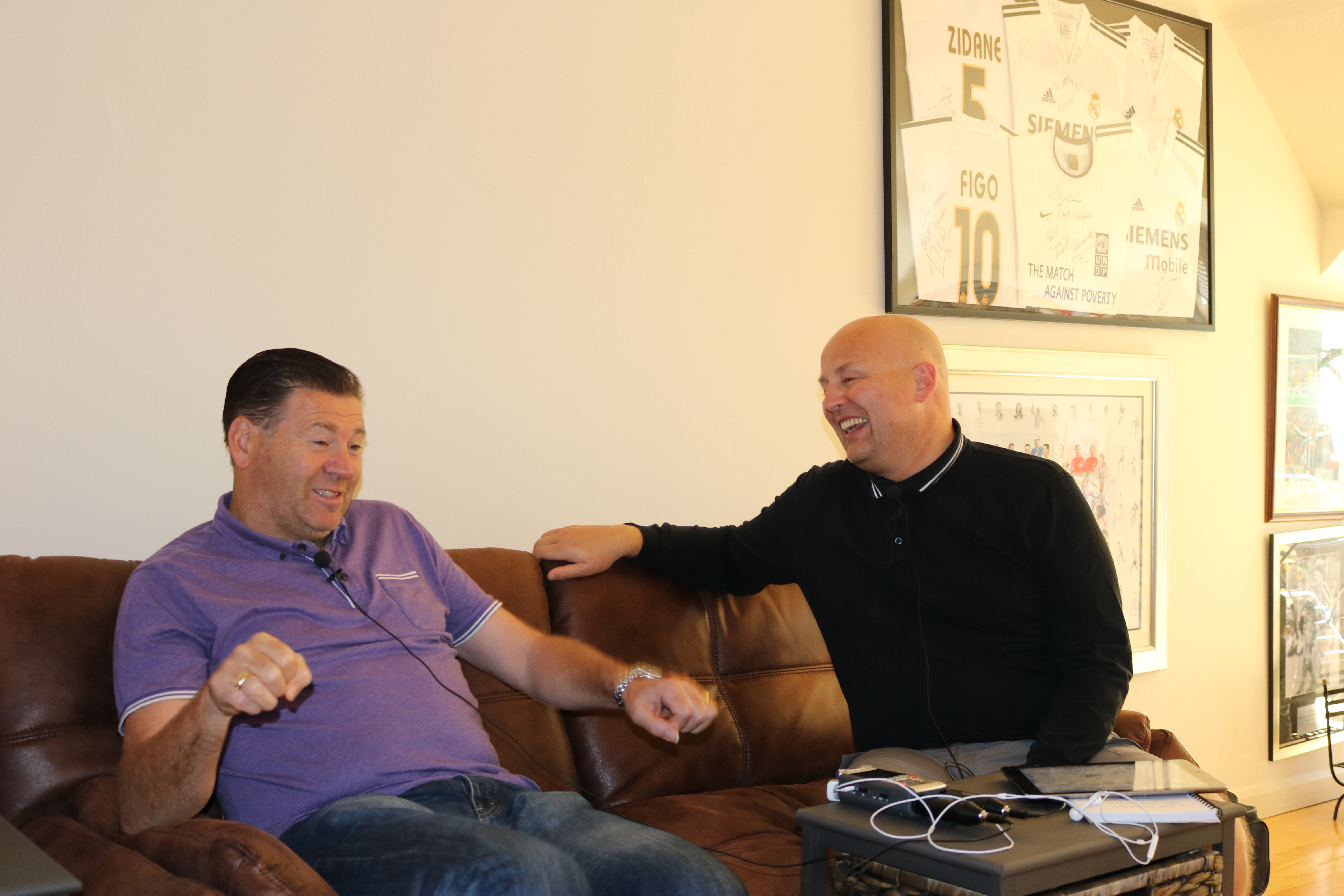
When he told BackPage and I this story, Chris stood up and mimed how the two men would arrive at training, leave the car and give a tiny nod of ‘see ya’ to each other and not speak again until the next morning, when they’d start with Nobby Stiles and Garrincha.

It’s the germ of an idea for Peter Kay for the next series of Car Share.

But it was told with wit and warmth and Chris’s natural raconteur style. I’m full of praise, I know, for the guests on the Big Interview podcast whenever I write or talk about them. But there’s a reason for that. They are not new to me, instead they are handpicked because I already like, admire or revere them.

Yet when it turns out that they are not only good at what originally attracted my attention but also natural story tellers, well, that’s an additional joy.

In this podcast Chris talks about playing motorbike-sidecar musical chairs with his brothers en route from the North-east to Watford in 1966. This is him reliving the moment. Loco.
IMG_0254

He’s engrossing about how Arthur Cox bullied him, remorselessly, at Newcastle. But bullied him into being a better pro, a dedicated winner and someone who valued professionalism as highly as he did entertainment. It was a painful journey but one which rewarded both men handsomely.

Karaoke, Top of the Pops, World in Motion, Beckenbauer, World Cup Italia 90, Jack Charlton, Gazza, Hoddle, Papin, Ossie Ardiles, Sheffield Wednesday, the technique of how to toast a full-back, being booted by defenders, England’s skills deficit and how to cure it … it’s all here.
And much more.

Chris also talks, calmly, honestly and carefully about depression and stress in football and emphasises one of the only sure-fire remedies to that feeling which sportsmen and women hide behind a positive exterior – quiet, hopeless desperation. That remedy is to talk, to share, to seek help and to realise that you are neither alone nor the first. Not anywhere close.

But it’s an upbeat, colourful, very funny chat. A morning well spent talking about a career well spent.
IMG_0265

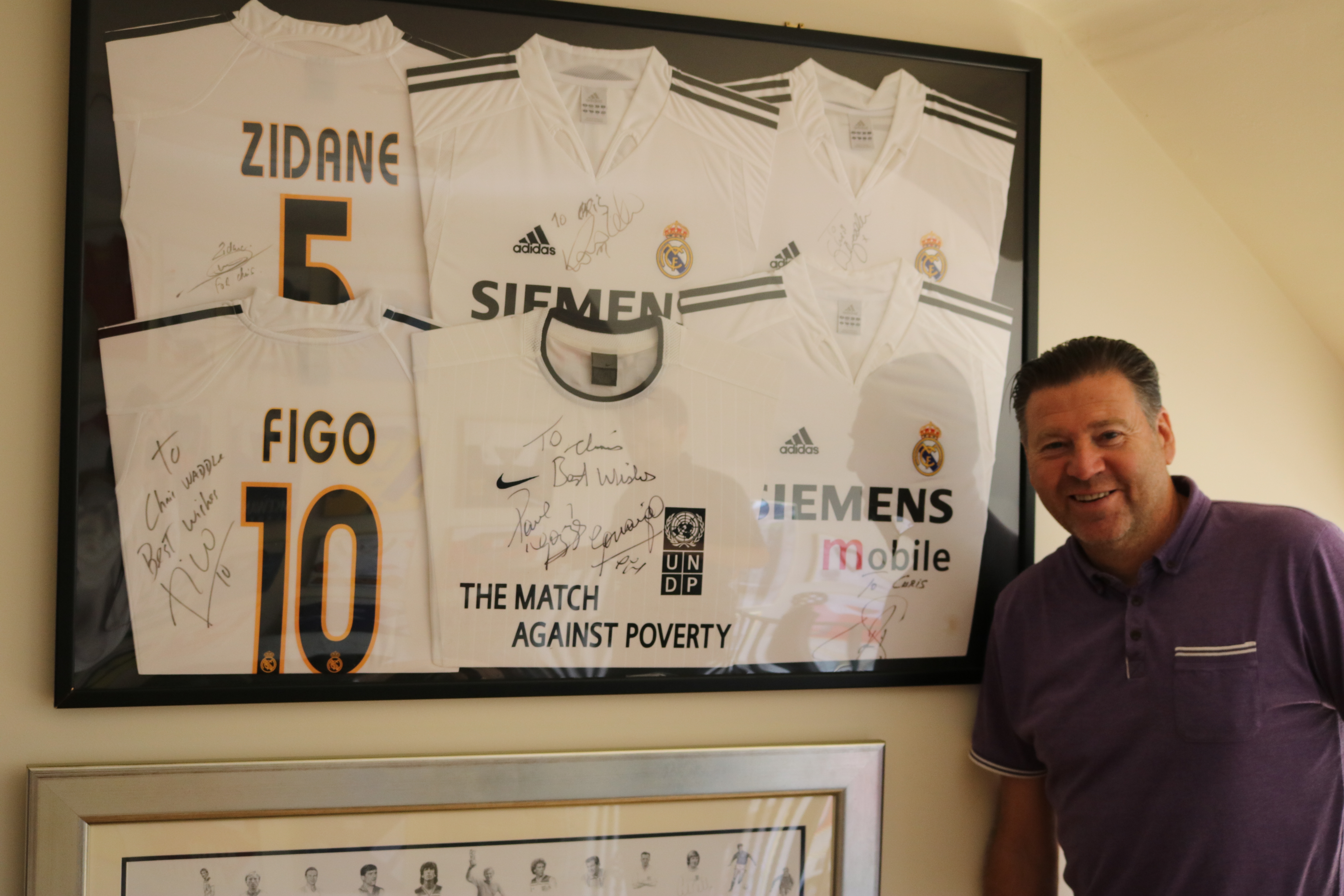
When the mic was off and we weren’t recording, Falkirk came up. When he signed at Brockville he was ushered to the ‘sponsor’s room’ and, literally, couldn’t get in because of the crush of people there. Several had to squeeze out the door so that the star signing could get in. He loved the eccentricity.

How did it compare to his welcome at Marseille when he became the third most expensive footballer in the world?
Quite well actually. On that day in southern France there was nobody from the club, no fans – just a clutch of French media who mobbed him.
Slowly it became clear that the initial conversation, in the reporter’s perfectly adequate English, was going astray.
“What songs will you be performing tomorrow night?” Chris was asked.
‘Wow! Diamond Lights DOES travel well!’ he began to think to himself with gentle satisfaction.
Until it emerged that the French media were convinced they were dealing with the lead singer of Pink Floyd, not Marseille’s expensive new winger.
Somewhere, a few kilometers away, perhaps David Gilmour was doing ‘doggie’ runs in the blazing sunshine, passing to and fro with Eric Cantona and crossing for Jean Pierre Papin to volley home.

That part we’ll never know. Everything else is here in the Big Interview. Enjoy.

The Big Interview with… Charlie Nicholas

Charlie Nicholas was a genius footballer for Celtic, Arsenal and Aberdeen. He has since become a Soccer Saturday legend on Sky Sports alongside Jeff Stelling, Paul Merson, Matt Le Tissier and Phil Thompson.

This new podcast is one of the most insightful conversations I have ever had. Charlie emerges as a true student of football and defies the ‘Champagne Charlie’ stereotypes.

All the big names are here – Fergie, Dalglish, Souness, McGrain, Cruyff – but it is Charlie’s honesty and depth that shines through. Here’s a video explaining why I chose Charlie to be a guest on The Big Interview.

The Big Interview with David Moyes

There is a mix of reasons why David Moyes seemed to me to be a good guest for the next Big Interview podcast. 

I’ve known him and his brother for several years; like me, he’s a Scot who’s ventured to Spain and, above all, the more I read him talking about his short spell at Old Trafford the more I felt that what he’s achieved in a long football career was being pretty much obliterated by less than a season at United.

He made his mistakes, he was very ill-served by many around him, he left and then fulfilled a long-held dream – working in one of the major football leagues outside England.

More, he was one of the few coaches last season who managed to get any joy out of a Barcelona side which not only made history in winning the treble but played a brand of football which re-ignited the love much of the world’s footballing public has had for them over the last 12 years. I wanted to hear how he described getting up close and personal with that bunch of players.

His links to Sir Alex Ferguson, tracking back to the 1970s, interested me; sampling some of the feel of ‘saving’ Everton and leaving them vastly safer, financially, plus a good deal better at football interested me; as did the fact that there has been a good deal of interaction with some of the most colourful characters of the last 35 years in his career.

Prior to sitting down and recording in the elegant Hotel Maria Cristina on the banks of the river in San Sebastian we watched training, chatted to local fans, spent a lot of time talking to David’s interesting and shrewd assistant, Billy McKinlay, and we [the lads from BackPage and I] also noted how the public of this Basque city – who stopped him every five paces when we were in the old town – are currently brimming with affection and appreciation for what he’s attempted to do so far.

Football is quixotic and, clearly, neither the brand of football nor the level of results in his time with La Real is anything like sufficient for him. To retain that affection much more will need to be achieved. But his personality has made an impact and it’s been a positive one.

At Euro 2012 I met up with David in Gdansk where he told me that one of the presidential candidates at Athletic Bilbao had recruited him to take over at the San Mames should he win the election [he lost, narrowly] in 2011. How ironic, then, to find him trying to rebuild their historic rivals from an hour along the coast.

Tune in to part one to hear us chat about Iceland, Cruyff, Celtic, Van Basten, Peter Stringfellow, Tom Finney, Scotland, Fergie, Drumchapel Amateurs and David Beckham.

And stay tuned for the second part – coming very soon – featuring Robin Van Persie, Gazza, Duncan Ferguson, Bill Kenwright, Wim Jansen and Andrés Iniesta

Hope you enjoy.

G

The Inside Story of the Euro 2008 Final

Eight years ago today, I was watching Spain win the first leg of their incredible treble.
This is the inside story of the Euro 2008 final. For the rest of the tournament, and the rest of the treble, check out the book.


Day 25. June 29, 2008. Vienna

Spain v Germany – The final of the UEFA European Championship 2008

Uno y dos y tres … ganar y ganar y ganar!

It has all been for this. “If we are not in the final then I’m a crap coach and I’ve organised a crap team,” Aragonés told them, well over a month before.
Spain’s royalty, football’s royalty – they are all here. At home the streets are silent, yes even in the Basque country, even in Catalonia.
Before leaving the Hilton, Aragonés seeks out Torres.
El Sabio and El Niño. The wise man and the kid. They’ve worked together at club level, now they are about to conquer Europe.
Torres has been in two UEFA European Championship finals before (UEFA Under-16 in 2001, UEFA Under-19 in 2002) winning each 1-0 and scoring each time.
Aragonés trusts him. They won Spain’s Segunda División in 2002.
Aragonés needs him. David Villa is injured and Fàbregas, with one goal in 31 internationals, will play second striker.
So the coach takes matters into his own hands. He goes to Torres, looks him sternly in the face, announces to him that Spain will win the final 2-0 and that he, Torres, will score both goals. At which point he grabs the striker with those two big bear paws and kisses him on the forehead.
“It’s something I did at Atlético,” he reveals later. “And it worked.”
“I came up a goal short,” says Torres through that perpetual, shy grin.
Now we are in the dressing room. There’s nothing new.
‘Pensamientos positivos!’
Uno y dos y tres … ganar y ganar y ganar!’
Aragonés is up to his high jinks before the kick-off.

JOSÉ MANUEL OCHOTORENA: “I remember that if players weren’t doing well he used to tell them that they had a stammer in their legs. And the team talk I’ll always remember is the one before the Euro 2008 final. He made us laugh by describing some of the Germans as having a stammer in their legs, too. He took all the tension out of the situation and somehow managed to transmit this sense of calm. The players went out onto the pitch looking forward to the game, determined to enjoy it. As they were lining up in the tunnel he went up to the German players and tapped one on the chest [Podolski] as if to say: ‘Aren’t you in good shape?’ He then gave [Joachim] Löw a big hug as if he’d known him for years and said, ‘Don’t worry, it’ll all be over soon’. Then he went up to say hi to the referees. It was brilliant.”

FERNANDO TORRES: “When we were waiting in the tunnel, ready to go out, and the tension was rising, he went up to the Germany captain [Michael Ballack] and said: “Good luck, Wallace.” He looked at us, smiled, and winked. What a way to take the pressure off! What a character!”

Germany start well. Spain don’t.
Thomas Hitzlsperger shoots on target. Casillas saves. Ramos misplaces a pass while being pressed by The Blond Fella and Miroslav Klose races into the box, but can’t finish.
It takes about 15 minutes but, from then on, it’s a technical knockout.
Ramos crosses and Torres hits the post with a header. El Niño begins to torment Per Mertesacker. Jens Lehmann saves astonishingly well as Christoph Metzelder involuntarily slices the ball toward the top corner of his own net.
The goal is smooth as silk, but also a little strange. Germany don’t see fit to mark Senna, who passes to Xavi, also unmarked. Löw’s team seems to be begging the man of the tournament to slice them open. Xavi. Unmarked? The flow of the ball has been precise and quick. Xavi takes, turns and releases a pass between Metzelder and Philipp Lahm, all in one velvet movement.
Torres is there. The striker’s first touch, off the instep, is a mis-control, but it looks great. The ball goes on the inside of Lahm, Torres erupts around the outside. It’s a race but Lahm looks sluggish and the Spaniard just manages to clamber past the defender, reach out a foot and dink the ball over Jens Lehmann.
The German keeper has been just slightly slow because, like Metzelder, he’s assumed that Lahm, a flying machine, won’t lose any race. Metzelder has stopped running and can’t get back to the line.
Torres’ right boot has clipped the ball such that it’s spinning like a top, right to left revolutions. Another couple of inches and it’ll go past the post but, instead, it nestles inside the panel of the net and that’s that.

FERNANDO TORRES: “I don’t remember much about these moments so many years after but I know that when I saw Xavi getting the ball in space between the lines I knew that was very unusual. If he was unmarked then the pass was coming, so I set off. It came to me and bounced off my boot a little further than I wanted. Lahm was a tad slow because he thought the keeper would come and Lehmann evidently believed Lahm would turn and get a tackle in, so he delayed. I got a little touch on it and watched it spinning and spinning as it went near the goal and I know that if the pitch hadn’t been watered properly, if the ground had been dry, the ball would have bitten instead of sliding and the spin on the ball would have taken it past the post.”

Spain celebrate this less exuberantly than the majority of their 11 goals in the tournament so far – it’s like they’ve always known that they’ll take care of business.
Then comes a moment which Aragonés has nearly foretold. The player who laughs most when El Sabio goes over to pat Podolski on the chest is Silva.
Off the ball, just after an hour, the two players noise each other up and go forehead to forehead. Both men seem to make a slight forward movement then both Ballack (Wallace) and Schweinsteiger (The Blond Fella) rush to the referee with arms spread wide, heads nodding forward like toy dogs – claiming that Silva has head-butted Poldi.
Roberto Rosetti, the Italian referee, isn’t having any of it. The Blond Fella rushes to the linesman to complain and, significantly, every last man on the Spain bench charges out to shout him down: coach, assistants, kit men, physios, subs – even Silvia Dorschnerova, who has been with the Spanish FA since 1982 and who is a much-loved match delegate, but who was born in Möenchengladbach.

SANTI CAZORLA: “They were all over us in the first 15 minutes and on the bench we were all saying that we’d have to turn things around, and quickly. Then Fernando scored and everything changed. Suddenly they were struggling to get the ball off us, we had complete control up front. Having said that, it was no walk in the park and we had a few hairy moments. We didn’t manage to score a second goal and Iker had to make a couple of saves. I was completely fired up by the time the boss told me to start warming up and went out and ran my legs off, determined to do my bit for the team. It was a great feeling and then when the whistle went – what a moment! Indescribable! The best feeling ever.”
Before the end, Ramos nearly scores with a header, Frings knees the ball off the line from Iniesta and a Senna-Cazorla-Güiza move so nearly ends up with Senna toeing the ball home from about half a metre out, but he just can’t connect in time.
Spain keep the ball like a personal secret.

FERNANDO TORRES: “I think we showed our personality. The way we defended that lead I’d never, ever seen in such a big game. There’s an entire history of teams who lead and then shut up shop, or a team which is 1-0 down and the ball just won’t go in for them. But we kept playing, kept attacking and above all we kept the ball. There came a stage when the German team couldn’t get a touch and they just looked at each other as if to say ‘What the hell is this?’ Even in that moment I was thinking: ‘This isn’t going to end here, this is the beginning. All these players love the ball, all of them have at least one more tournament win in them.’ And so it has proved.”

The whistle goes and this project has achieved its objective. Spain are champions of Europe.
I asked Thomas Hitzlsperger to describe the experience of playing them. This is what it was like.

THOMAS HITZLSPERGER: “Last time I had played Spain it was at under-21 level, against the Torres-Iniesta team and we lost, so I didn’t have good memories. But we felt in the final. We went in with positive minds, relying on our well-known mentality and hoping that they would take a very wary look at us. They had the skill advantage; we had the advantage of being Germany. This was big. We knew they were better than us, but we really believed in our history and the fact that we still had some quality. We hoped it would be like playing England. You respect them but, generally, in crucial games we come out on top. We honestly thought ‘We are better at this than them’, we thought they might choke. But they didn’t.
“We played 10 or 15 good minutes and if we had scored then you never know, but that was when their quality just took over. Look at the score and it only says 1-0, but we were well beaten. We had some problems coming into the game because there was animosity amongst our players. The Spanish team, I think, totally knew each other, played for each other and you could see that, finally, they had complete belief in themselves. They also knew each other’s games so well. All this we could feel.
“Xavi and Iniesta always want the ball. It doesn’t matter the occasion, the state of the game, the pitch – they protect the ball, they try to attack. Some midfielders, if they lose the ball they try to win it again, but they protect it next time by dropping deeper, making an easy pass. These two don’t do that. They have absolute confidence and they always use the passes to create space or move forwards.
“Losing, even to a top side, was so disappointing. Devastating. But it isn’t just that Spain put themselves across as humble – it’s true. They are the best in the world at football, but they are great human beings. On the pitch they are there for each other, off the pitch they treat you with respect. They never come across as having big egos. They were celebrating their win but Mario Gomez told me that when he asked them to swap a couple of shirts after the game they were only too happy to stop celebrating, help him, have a little chat and wish him well. They could have said, ‘Leave us alone, we are celebrating now,’ but they didn’t. They took time. Good team, great people.”

And when he says celebrating, he really means it.
There’s something called a ‘flash’ interview area in the reception area between the two dressing rooms, just at the point where the tunnel to the pitch begins. The world’s television stations who have paid millions for the rights to broadcast this tournament live wait there in demarcated stalls – a moveable screen on either side of them and the front end open. A stall. It is to here that they will try to entice the winning players (of this or any other modern tournament) to speak live as soon as possible after the final whistle, so that the programme back home (be that Spain, Germany, UK, USA, Saudi Arabia, France, Brazil or wherever) is still on air.
It is often frazzled, but not this time. The players simply take over. Casillas, Villa, Sergio García, Güiza, Pepe Reina, Puyol and Ramos dance about, a few of them only in their swimming trunks, singing the Seven Nation Army chant while spraying champagne over every camera, every microphone, every presenter, Reina with the giant trophy balanced on his head. It’s an uncontrolled orgy of happiness.
Villa and the Canal Cuatro reporter Juanma Castaño are good friends and, having utterly soaked him, Villa comes back with a towel to pretend to dry his hair (all the while this is going out live) and he takes the microphone to do the reporter’s work for him: “Welcome to Vienna – you are live with the f***ing champions of Europe!”
Then, a little further down the line of their champagne supernova, Spain, led by Iker Casillas but with Rubén de la Red, Santi Cazorla and then about half the 23-man squad behind them, dance their conga line through the mixed zone where the German television stations who aren’t live are interviewing Bastian Schweinsteiger. The Blond Fella’s interview with ZDF TV is drowned out and he has to briefly pause but, initially, Schweini takes it in good spirit. Less so when the conga line doubles back a few seconds later and snakes past him in the other direction, singing ¡Y viva España!
Knowing Casillas, I’m pretty sure that, retrospectively, he wishes they’d chosen another way to celebrate.
Clothed, but not completely sober, the red army finally leaves the Ernst Happel, hits the airport and takes the Milagros Diaz plane back to Innsbruck. There, they jump on the Pase lo que pase – siempre España bus all the way down to Neustift, their little hidey-hole in the Tyrolean valley.
After a quick stop at the Milderer Hof hotel at 4am, it is a quick pizza in Café Anny before everyone moves to drink, sing and dance in the Dorf-Pub. It is wild, sweaty and totally deserved.
“It was like a sauna, but we drank enough liquid,” Aragonés reminisces fondly. Herbert Hofer, owner of the Milderer Hof, has organised that the basement of the pizza place and the pub are basically off limits to the public, but open until breakfast for the European champions.
Beer is the order of the day, there are embraces, choruses, photos and no trouble. No paparazzi. Aragonés is the first to go, at 6am and, one by one, his troops follow him as they have done from the low point of Windsor Park, Belfast, to the summit of Europe.
Marcos Senna is one of the earlier players to leave, having been so drunk in the stadium that he reckons he could see four reporters when he was only talking to two.

CARLOS MARCHENA: “One thing I’ll never forget is myself and Raúl Albiol being brought back from the party in Neustift in the back of a police car, dressed up as cops because they lent us their jackets and hats. We just said to each other, ‘Today of all days anything goes!’”

Marchena, the Andaluz from a little town of 16,000 inhabitants in Sevilla province with the record of never having played in a losing Spain side (which will last beyond World Cup 2010); Albiol the Valenciano from 700km to the north-east of Andalucia. Different accent, different upbringing, different allegiances. Brothers now.
The last to leave are Torres and Villa. Very different guys, very close friends. The pichichi of the tournament and the tournament winner. Little Austrian kids are en route to school when the saturnine son of a miner from Asturias in the north of the country and the tall, blond, shy Madrileño from the heart of the nation’s capital make their way. El Niño y El Guaje – The Kid in Spanish and The Kid in Asturiano.
Once their differences would have divided them. Under the Wise Man of Hortaleza Spain have done the wise thing: united, bonded, had fun and won.
Uno y dos y tres … ganar y ganar y ganar!

Germany 0 Spain 1

Germany: Lehmann, Friedrich, Metzelder, Mertesacker, Lahm (Jansen 46), Hitzlsperger (Kuranyi 58), Frings, Podolski, Ballack, Schweinsteiger, Klose (Gomez 79).

Spain: Casillas, Sergio Ramos, Puyol, Marchena, Capdevila, Senna, Iniesta, Fàbregas (Alonso 63), Xavi, Silva (Santi Cazorla 66), Torres (Güiza 78).

Goal: Torres 33.

Kevin Bridges: Mourinho and Me

Kevin Bridges is one of the UK’s funniest stand-ups and a serious football fanatic.

I’ve known Kevin for some time – when we started doing these interviews, I knew he was one of the people I wanted on the show. You know how funny he is, what a great storyteller – but maybe not how much he knows and loves the game we all care about.

In this conversation, he finds the funny in a brief encounter with his Celtic hero, Henrik Larsson; his love of FC Barcelona; a memorable trip to the Super Clasico in Buenos Aires; and the day he compared notes with Jose Mourinho.

I hope you enjoy it. If you do, please let the other football fans in your life know about these interviews.

G