Graham's Blog

Hi Graham, it’s Johan

This felt like going full circle. Berlin not Barcelona, but Cruyff again. 

Outside of my childhood Aberdeen heroes, it was Johan who absolutely riveted my attention from 1971 onwards on the brief occasions that I could watch Ajax dominating Europe on Sportsnight or when the BBC showed the European Cup finals, three of them, that the ‘other’ team in red and white won consecutively. 
 
By chance I was in Barcelona, working, when Cruyff was sacked by FC Barcelona and, unbeknownst to me, the tectonic plates of the football world moved irrevocably. 
 
Joan Laporta decided to protest, his movement led him to be president seven years later and ‘Cruyff principles’ were re-introduced to the Camp Nou. Coincidentally the ‘sop’ to the Barcelona fans for Cruyff’s sacking in 1996 was Luis Enrique being pinched, on a free, from Real Madrid. How did that end up for Lucho and Barça?
 
During my life in Barcelona I’ve met and interviewed Cruyff a few times – nothing was cooler than him phoning me at my house ahead of the 2011 Wembley final and saying: ‘Hi Graham, it’s Johan’. That’ll do it for me. 
 
While here I’ve seen football the likes of which has never been played before and while it’s been Ronaldinho, Xavi, Iniesta, Etoo, Piqué, Busquets, Messi, Neymar, Suarez performing it, rather than Johan himself, none of it would have taken root here, specifically, were it not for him, his teachings, his influence. Without Laporta, Begiristain, Guardiola all believing fervently in his football philosophy.
Basic RGB
 Dan Leydon’s art for my book on Barça, illustrating the through-line from Cruyff to Messi
But this picture shows the two of us in Berlin, last November, just a couple of weeks before his cancer diagnosis – so far, so good on that particular fight.
 
We were to talk about youth development, football philosophy, how to steer a modern club which wants to embed technique and tactics in its central nervous system. 
Around us, representatives from AC Milan, Sporting Lisbon, Athletic Club, Everton, Spurs, Zenit, Inter, Manchester United, Atlético, Feyenoord, Benfica, Borussia Dortmund – many many more. 
 
‘Be firm with him, don’t let him meander off into his own musings’ Johan’s minder affably warned me before the hour-long interview. ‘He’s in a good mood, he enjoyed that’ she said post event. 
 
Me? I knew that I’d spent the morning with, pound for pound, the most important and influential man in the history of football. 
Doesn’t get much better than that. 

Bergomi, Baresi, Tassotti,Battistini … and McAvennie

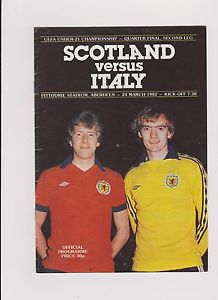
There were a couple of reasons why I wanted to start an interview with Frank McAvennie not about Stringfellows, West Ham, court cases or putting Scotland into the 1986 World Cup, but about him knocking Italy out of the Under-21 European Championships.

When I began to be taken to Pittodrie in the late 1960’s my Dad would initially only take me to see the reserves play (in Chelsea-style all royal-blue). I would fixate on which young players I could spot and then follow as they forced their way into Eddie Turnbull’s first team.

Then, in 1973, when I was ten, someone gave me the SFA Centenary annual which contained every Scotland lineup, fixture and score. I pored over it looking for patterns – who emerged only to be dropped permanently, who disappeared for a year then came back to play 40 times… typical football anorak kid. I wanted to know their stories. I wanted to know ‘why?’ The Little Interview was carried on in my head.

But there were also details of B team games and Under-21s: I wanted to see who were the tyros who were spotted young and then made it big.

So in Spring 1982, as I was preparing to spend that summer in Spain for the World Cup, I was stunned to see Scotland go to Italy and knock the mighty Azzurri out of the Under-21 European Championship. Particularly as Aberdeen’s magnificent Neil Simpson was the dominant midfield player in that team and Jim Leighton was in goal.

Italy programme

Those with elephantine memories will recall that Scotland then lost a Euro semi-final to England who went on to win the tournament. Jolly well done, England.

But pre-internet and with no broadcast of that tournament, I didn’t know the caliber of footballer that Scotland team were up against. The following years would prove that Mauro Tassotti (three Champions Leagues and five Serie A titles), Franco Baresi (three Champions Leagues, six Serie A titles), Sergio Battistini (two Uefa Cups]) and Beppe Bergomi, all in the starting XI against McAvennie and company that day, were quite good.

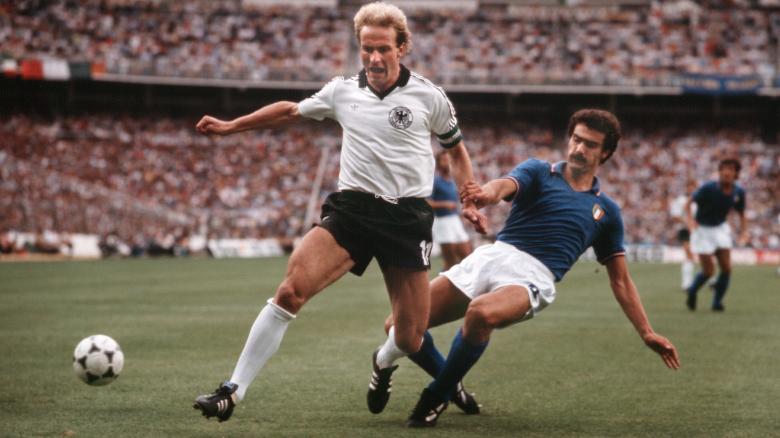
Bergomi, Frank’s direct marker that day, was in the starting XI for Italy which won the World Cup final against Germany in Madrid only five months later. Think about that.

bergomi

I’ve never seen footage of the Italy match, I’ve never read anyone talking about it and I still think it was an standout achievement – something indicative of not only how much more talented our footballers were back in those days but how much more competitive, possessed of a mentality I yearn for in Scotland teams today.

So, that’s why I started The Big Interview with Frank McAvennie, who scored the only goal of the 180-minute tie, talking about a game 34 years ago (which seems like yesterday to me) and spent the rest of the Boys of ’86 discussion wishing I could get him back on the subject of Catanzaro, the locals throwing stones and bottles at the Scottish players and three of the Azzurri’s all-time greats being put to the sword by our own boys in blue.
Cheers Frank.

The race for the title: 1986

By Neil BackPage

When we were planning the Big Interview with Frank McAvennie, we settled on a strategy very early on (this is unusual for Graham, Martin BackPage and I): we wanted it all to be about West Ham’s 1985/86 season, the club’s best-ever top-flight finish and McAvennie’s first in England, 30 years on.

McAvennie talked as well as we hoped he would about that season. His transfer from St Mirren in the summer of 1985; the television blackout that made him virtually anonymous despite leading the league in goals – until he showed up with Denis Law on Terry Wogan’s chat show; his partnership with Tony Cottee; the forgotten craftmanship of Alan Devonshire; the fatherly guidance of John Lyall. But his description of the run-in that season had us re-reading the narrative. Listening to the tape for a second and third time, we were still piecing together the twists and turns and the anachronisms of the final days.

First of all, the protagonists. Liverpool, Everton and West Ham United. This in itself is peculiar, as it was another club, Ron Atkinson’s Manchester United, who had started in devastating style, winning 10 out of 10 league games at the start of the season. So complete was their collapse from that position, they were out of it by the end of February.

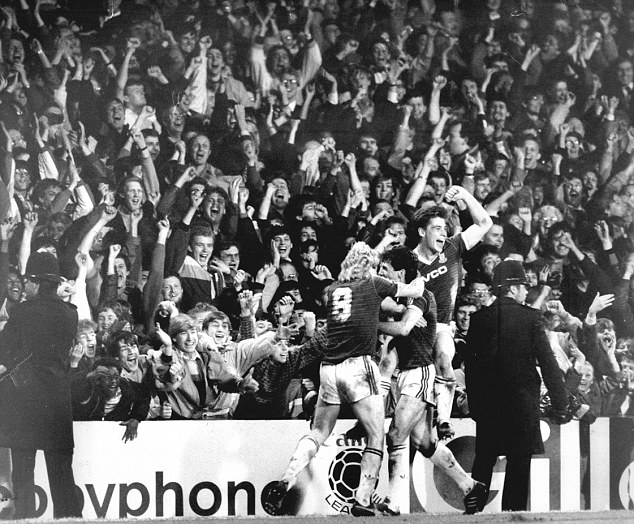
West Ham moved into contention at around that time – it was they who knocked United off their perch at the start of February, one of only two games they played that month due to the weather. That left them with a huge backlog of fixtures. They had five games in hand over Liverpool at one point. They would play eight games in March and nine in April.

WHU

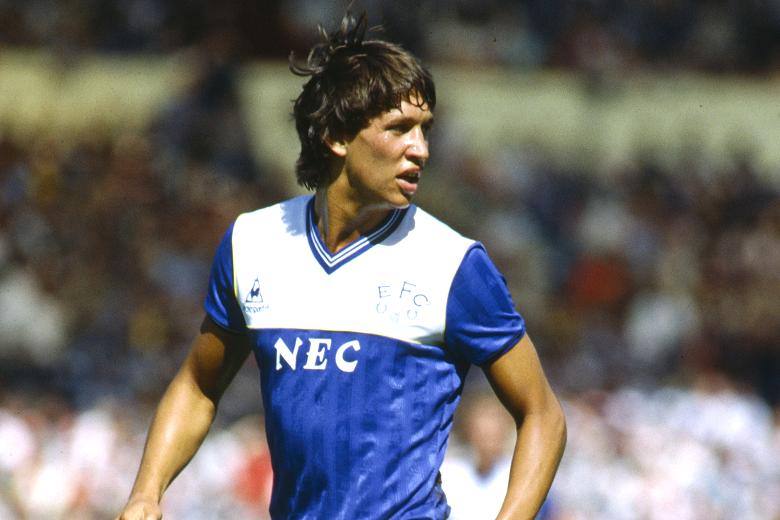
Everton were the defending champions (with no European Cup campaign in the first year of the ban on English clubs) and had new signing Gary Lineker on his way to top scoring in the league and then the World Cup, for England. They entered the final days of the campaign at a disadvantage after a shock loss to Oxford United in an evening game on April 30.

lineker ev

Then there was Liverpool. In Kenny Dalglish’s first season as player-manager, their season was a mirror image of that of Manchester United. It ended with them taking 34 points from a possible 36 in their final 12 games.

Kenny D

Liverpool played their final game on Saturday, May 3, 1986. Everton and West Ham also played, with both teams scheduled to go head-to-head the following Monday to complete their schedules. At 3pm on the Saturday, all three had a shot at the title.

If Liverpool lost at Chelsea, who would finish sixth, then either Everton or West Ham would be champions with two wins in 48 hours. A draw at Stamford Bridge ended Everton’s hopes, but West Ham could still win the title. A win for Liverpool in London on the Saturday ended it there: Monday’s game became a shoot-out for second place.

McAvennie and Cottee both scored in a 3-2 win at West Brom. Everton destroyed Southampton 6-1. Fans of both teams were stuck to their radios for news from Stamford Bridge. And the news was not good. Dalglish scored the only goal of the game.

“We came off the pitch and we got told it was a draw at Stamford Bridge,” remembers McAvennie in the podcast. “Then we got told Kenny had scored. I’ve never seen so many grown men cry.

“I didn’t want to play on the Monday. All we needed was Chelsea to draw with Liverpool. We would have battered Everton on the Monday.”

Frank McAvennie: The Boys of 86

It’s 30 years since West Ham United’s best-ever top-flight finish. That was Frank McAvennie’s first season in English football and it was packed full of the most incredible stories. They’re all here.

The television black-out that made the summer signing from St Mirren almost anonymous in London despite leading the scoring charts; the team meeting that forged Frank’s incredible partnership with Tony Cottee; the three-way fight for the title that would have gone down to the wire were it not for a certain Mr Dalglish; there are cameos from Terry Wogan and Denis Law; questions from Russell Brand; a special appreciation of a special man in John Lyall. And 30 years on, a sense of the impact those special seasons have on the footballers and fans who experience them.

Gary McAllister: When The Town Believes

Meeting Gary McAllister – in Leeds, no less – reminded me of the achievement of the championship team he played in at Elland Road. That midfield: two academy graduates, Gary Speed and David Batty, and two Scottish recruits, Gordon Strachan and Gary himself, is brilliantly explained by Gary here.

There’s also insight into how a suspected prank phone call turned into one of the all-time great ‘Indian summer’ signings and a trophy treble with Liverpool. Scotland supporters, be warned: this podcast contains traces of Euro 96.

Enjoy!

Graham