LEFT WING POLITICS – GINOLA MAKES HIS STAND

Perhaps David Ginola will get the required nominations to run for FIFA President – perhaps not.

But I don’t think that those of us who despair about the manner in which FIFA is scarring the sport we love while remaining untouchable can afford to let the sound of the Frenchman’s common sense be drowned out by anyone in the media who’ve lost their soul, lost their cojones.
Why, when what we desperately need is a credible, supportable alternative to the tired, discredited, deplorable Sepp Blatter era, should lethargic, complacent cynicism rather than open-minded interest be the first reaction? It’s the kind of behaviour which the utterly discredited Blatter depends upon in order to rule. And keep ruling. Quasi-collaboration.

But whether Ginola is tripped up at the first hurdle or whether he storms to the presidency and boots Blatter out of the door in Zurich, some good has already been done. Someone of substance and worth has stood up, using the same kind of language about FIFA as fans all over the planet do. Usually in frustrated anger.

Why is FIFA free to do what it wants? How can a 78-year-old man around whose administration there have been numerous allegations of corruption be in the right shape to run the world game for another four years? At a time when it is reportedly under FBI investigation, why won’t the sport’s governing body force out corruption and adhere to a policy of transparency and accountability? How did a bidding process end up approving a World Cup in Qatar in 2022 when everyone knew it wasn’t fit for purpose, that it couldn’t be played in summer?

I call on those prejudiced by that process, most notably England, Australia, Wales, Scotland and Northern Ireland to make formal their support and nominations in favour of Ginola. Let the man run. Let Blatter be answerable to Ginola’s manifesto.
I was invited to speak to the former Spurs and Newcastle winger yesterday afternoon and here’s what we said. Make your own mind up.


Graham Hunter: What’s broken about FIFA? What drives you to try and win this hugely important position in world football?

David Ginola: It was inspired by talking to people around me. Regarding FIFA behaviour and decisions, so many people told me: ‘We don’t understand anymore.’ There is no trust. Football decisions and decision makers must earn trust. I think that is why. If you want to make positive and fair decisions about football and its development, then people around the world need to understand why and how decisions are made. It must be a transparent process.
I knew it would be a difficult task obviously, but also very exciting and interesting; to make people confident that all the decisions made at the top of football are fair, well-explained, without controversy or doubt.

GH: What part does the theme of respect play in your choice to try to run for presidency?

DG: Respect is everything. I’ve spent most of my time in football, I dreamt about becoming a professional when I was only nine, I signed my first contract aged 19 and then for both good and bad I spent the following years in a very emotional football life. Passion is very important but the word respect is used a lot – it is said as a word, but there isn’t always the act of respect next to that word: respecting the game, the people; knowing that if we have had the chance to earn a living in the game it’s because millions of people buy season tickets or subscribe to TV broadcasters.
You must respect all that. Around the world it’s fans who have made football the greatest and most popular sport on earth. They should get the rewards from that.
Football is not just an elite bunch of people: football belongs to the people. Anyone, anywhere on the planet who loves the game. In FIFA you should be rewarded for what you do towards the people who make football, not rewarded for what you do towards yourself.
Football decision-making needs to be more approachable, something which makes more common sense to people. Shown as something very transparent. We need to demonstrate integrity, and dignity. As a person, as a decision maker. It’s not about yourself. Your personal position should be at the bottom of the list.

GH: I understand that you associate with the trend at Bayern Munich for incorporating their great ex footballers, Beckenbauer, Rummenigge, Sammer, even Hoeness into how that club is run? At Barcelona over the last 10 years there was youth, energy and vision from Laporta, Begiristain, Soriano, Rijkaard and Guardiola – are these themes similar to what you want to bring to your FIFA presidential candidacy?

DG: Yes, definitely. I read an article by Laporta recently suggesting that if he were in charge of PSG then he’d ‘immediately take on board David Ginola’ because he thought I’d represent as a man, as a symbol, as an ex-player what Parisian football needs.
I believe that one of the things Laporta’s Barcelona achieved was to put the formation and education of their players as young men before their formation as footballers. For players to be able to understand what life is all about, to understand what fame is all about, what making money is all about. How to be prepared and to cope. This philosophy is great because if you form the footballer before the man it’s leaves many more complications.
Speaking more broadly on that subject now, I think we in football would have a better understanding from fans around the world if we can improve the way we educate and teach developing players.
I’d like professional footballers to be more aware, via their education and formation, that the reason they are standing there on the pitch, playing football, doing the thing that they love most and being paid for it is simply because there are people, fans, who are paying good, hard-earned money to come to the stadium to watch that game. It’s imperative for those within football to comprehend and not ignore that. I always praise the fans and the people in the football infrastructure because they can make you great … they can change your life. I’m faithful to the concept of the debt we owe them and I’d love to see that more often being part of the mentality of modern football.
I want people to trust us in FIFA – to trust decisions. I want it to be clear that the decisions we’d make in charge of football would be fair, clear, sustainable and able to be backed by the majority of fans.
Take the example of Bayern. Of course, intelligent former footballers working in harmony at the top of the club for the good of the club is the best thing you can do. People like us know football inside out. You have people working on the financial side, on the marketing and so on, but as a former footballer it enables you to think not simply about the rectangle of the pitch but what football represents as an entity around the world. It allows you to make the right choices, to consider problems which might arise and to take decision not just because you think it’s right for you but right for the great majority of the people who are important – fans and players. You think more widely, consider more.

GH: Since retiring, you’ve acted, you’ve represented Red Cross, Unicef, you’ve produced award-winning wine, become a respected football analyst on television, advised a football club in France – it appears you put effort into projects and that people seem to trust you?

DG: Ask Red Cross and Unicef why they made those decisions to ask me to represent them. I guess it’s because they think I’m a man of integrity. When I speak, I’m honest … I’m a cool guy. ‘I’m a cool guy’ … that’s what represents me best. Saying ‘cool’ doesn’t mean I’m not serious or egotistical. But I’m down to earth, I’m respectful. Wherever you come from, whatever your creed or colour, it’s not a question for me. I’m very approachable. Very passionate. I think most of all it’s integrity. When people look deep into your eyes this is what they see. This is who I am. And I hate talking about myself this much!

GH: Do you really believe you can tolerate the dirty world of football politics? Can you genuinely cope with that?

DG: I understand, but this is exactly what we want to change! We want to show that a world association like FIFA can be trusted. That people can feel: ‘Wow! what a change!’ We had ‘X’ before but now we have people who actually are transparent in everything they do. You have to think of it like a charity. In a charity, you do things for others. Spending money for others, do the right thing at the right time for the people who need it. Simple as that. No politics. No hiding, no secrecy. As president I’d want to be able look at myself in the mirror and know I have nothing to worry about. That we made the right decision and we’ll explain it to you. Our administration would explain what we considered and why we chose this way over that. People have a problem with FIFA because they don’t explain openly enough. And then when they do explain, it’s not clear. Not clear at all. There’s controversy. This is the thing that shouldn’t happen in football. Football is a sport, not politics. There’s politics when money is involved, but I want people to understand that FIFA, under us, can be crystal clear. Sport is for the people – I want to give it back to them.

Revista Revisited … Valencia’s chain of command

Revista De La Liga may be in the can for another week, but this is an opportunity to push Graham into extra-time.
In the second part of ‘post-match Revista’, he reflects on the burgeoning career of young Scot Ian Cathro, currently the assistant to Nuno Espírito Santo at Valencia, who was interviewed by Sky’s Charles Paterson for this week’s show.

Ian Cathro is a 28-year-old Scot who has never played professional football but is the assistant manager at Valencia. Is this the right club at which to advance his career?

Ian is there because of Nuno. Nuno is there because of Jorge Mendes. Jorge Mendes is there because of Peter Lim. There’s a hierarchy which means that he is not just a 28-year-old Scot who is learning Spanish from Portuguese. There is a clear line of importance from manager’s consigliere, part of the personal regime of Jorge Mendes – the world’s most important football agent, who has been Peter Lim’s consigliere as he tries to buy the club. Although the documents aren’t signed yet, it’s close.

There’s been a healthy sprinkling of footballers who have been brought in – and are as new as Ian, and therefore not sitting at the Mestalla saying ‘show us your medals’ and all that kind of rubbish. Those new players owe their presence at Valencia to Nuno, Peter Lim, Mendes or a combination of all of them. And, therefore, Ian Cathro – talent aside – is an extension of the regime and, as such, there is a collegiate feel to it. It’s far less hierarchical or sniffy, and that is a platform in which I expect somebody of talent to be able to express himself.

Nuno is very much a frontline, on-the-training-ground guy. His man-management, his ability to inspire people, is probably his biggest calling card. That, rather than the way in which Paul Clement at Real Madrid has been asked to take sessions so that Ancelotti can observe, is what gives Ian Cathro more room to be the guy giving wise words to Nuno: ‘This player’s on form, this player needs to be taught this or that’. His input is probably more vital at this stage to the manager than maybe his one-on-one work with the players. That’s my impression, but it is one that I hope to sharpen by going down and meeting the pair of them.

It’s potentially the right place for a young Scot who hasn’t been a professional footballer. However, it is a very, very critical environment. Valencia’s fans absolutely believe that they should be winning the league and should be competitive in Europe. Over the generations, they have been fed, with that. We can speak progressively and optimistically now because the displays are there, the results are there. If that were to turn over the course of five or six games then they would all find it a more testing ride. But, at the moment, there is a crest-of-the-wave feeling which goes beyond the fact that they have been recording relatively positive results.

Revista Revisited … the Casillas question

With another episode of Revista De La Liga in the can, this is an opportunity for Graham to expand on some of the issues discussed in the bar.
In the company of Scott Minto, Guillem Balague and Terry Gibson, he reflected on the possible dropping of Iker Casillas and the impact of Ivan Rakitic at Barcelona.
Here we dig a little deeper into those two issues.

There was lively discussion in the Revista bar about the report in Spanish newspaper Marca that Iker Casillas may be dropped for the Elche game tomorrow [Tuesday] night. So long as Marca’s story is correct, is it the right call by Carlo Ancelotti to drop his No.1 goalkeeper?

I’ve got a particular allegiance to Casillas not because of friendship or experiences shared, but because he has always been an idiosyncratic goalkeeper who represents something from a slightly different age. One of the reasons he didn’t fit with Mourinho is that Mourinho believes the more detailed and scientific your preparation, the more likely you are to succeed. And his record shows there is a lot in that.
If I saw a player beginning now the way Iker has constructed his career, it’s likely that I would be saying ‘You can become more mechanical, more invested in the percentage actions coming off for you’. But he’s got where he’s got to based on very hard work, very great talent, but something else that comes up in the Spain book…
Back at Euro 2008, Jose Manuel Ochotorena, the Spain goalkeeping coach, made it clear that they had all the information to tell Iker what he needed to know about the Italian penalty takers [in the quarter-final, which Spain won 4-2]. And Iker said ‘No, leave me’. Ochotorena walked away knowing that Iker had to go into his zone. He thrives on instinct. He has become San Iker – Saint Iker – because of going into a zone in moments of high pressure; something innate comes out.
That innate part of Iker Casillas has been chipped away at so much over 50-plus league weeks out under Mourinho and Ancelotti, plus the jeering from fans he thought should be devoted to him, then the enormous psychological and spiritual cost of winning La Decima last season then the humiliation of the World Cup. If you base yourself on planning, science and technique, then you have things to fall back on that are not simply ‘do you feel well in yourself’.
Right now, if you look at Casillas’ form, this season he has been mostly faultless for the goals that Real have conceded. Sir Alex Ferguson made decisions in his career which were strategic, soaked with years of experience and included risk. At the end of it, when he had won the trophies to prove he was the best, he identified that taking the decisions that others were scared of was fundamental to him.
If Marca are right and Iker is to be dropped, then while I will remain an Iker supporter and sympathetic to what has happened to him and the way in which he has been undermined, I will certainly understand that Ancelotti is trying to lance a problem at a time when his team have scored 13 goals in two games; that has given him the breathing space to look analytically and say ‘We’ve won the last two. I can argue that Iker is not being blamed but I’m going to take a brave, big decision’. For that reason, IF Ancelotti goes ahead with [dropping Casillas], I’ll be more supportive and more analytically appreciative of it than I would have been otherwise.

We talked about the positive impact Ivan Rakitic has had on Sergio Busquets, but how big an influence has the Croatian been in helping Barca recapture something of the high-tempo, hungry elements which defined the start of Pep Guardiola’s reign at the club?

Xavi said that the atmosphere, work ethic and ‘feeling’ reminded him of the beginning of the Pep era. I think it’s been reported as him saying ‘the team is playing Pep style football’, but it was more like an old-fashioned weatherman sniffing the air and saying ‘it smells like rain’. I think that is your first marker that things are tighter, healthier, more focused, intense and unified.
I would argue that across the span of the Pep years, if we are comparing the very early months of Luis Enrique, the span began in a pretty blue-collar manner. The treble, exciting as it was, was a very gritty year. They played lovely football but it was based upon some wins which were pretty gnarly – the win away at Donetsk, the 3-2 win against Betis, the bare-knuckle 2-0 Clasico win, the 3-3 draw with Villarreal towards the end of the season when Iniesta gets injured, then hauling themselves back into it in the last seconds against Chelsea – there was just a sleeves-rolled-up, everybody-in-it-together element which I think doesn’t compare to the football apogee of the Pep years, which would probably be the 2011 final and the World Club final against Santos.
That arc began with blood, sweat and tears and I think what we are seeing across the board now is an influx of new blood, new enthusiasm, players who are thrilled to be at Barcelona. I look at Vermaelen’s work to get fit, I look at Sandro, Munir, Mathieu and undoubtedly Rakitic, and you see guys who would have given anything to be bought by Barcelona and paid massive money to be there.
In terms of the work ethic, there’s an important connection [between the two eras] in the manner of making every second of the working day count. Luis Enrique has re-instituted the breakfasting together at the training ground, the absolute intensity of every minute in training – there’s a correlation between that and this group of players separating themselves from the other blue-collar teams in La Liga who want to frustrate, stifle and outwork them.
Rakitic embodies all that is good. He looks like he can’t believe his luck. He spoke at length about having turned other teams down and that would have included Real Madrid; the brand of football is exactly what he lives for, but there is his willingness to be defensive, to be the pivote, to allow Busquets time to push forward.
[Against Levante], when he clears the ball from the back-post area with a brilliant, saving tackle, if you look at him as he is racing back, he has taken a little look over his shoulder to see where the Levante player is rather than just focusing on the ball and how he is going to clear it. That’s the run that Busquets would have had to make over the last two seasons. Exceptional though he is, Busquets is not as quick as Rakitic. There will come a stage in the season when Barcelona will have to rotate Rakitic – as they did in midweek against Apoel – because of the amount of ground he is covering.
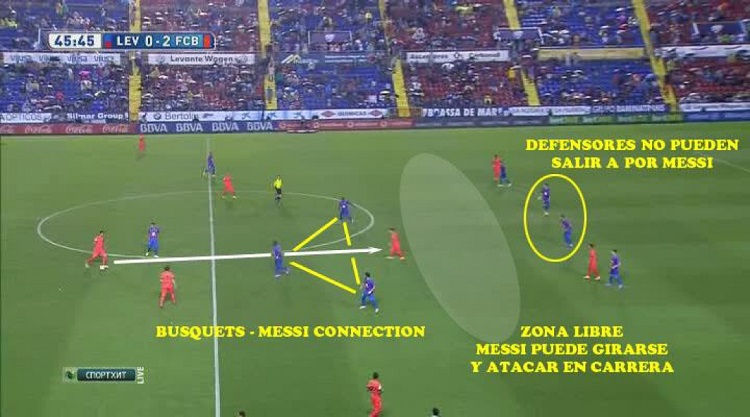
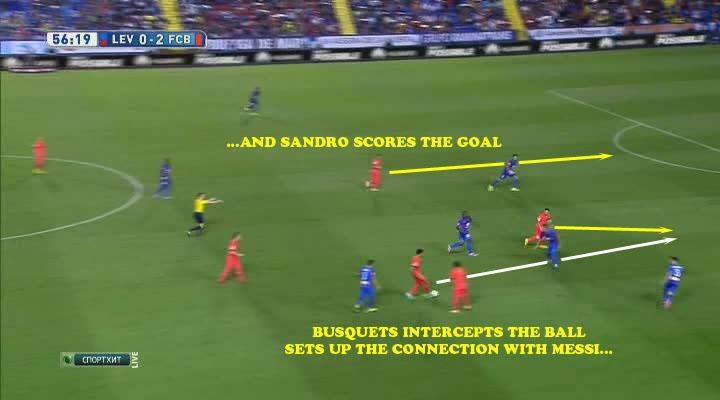
In the Athletic game, there is a fabulous Busquets pass to Messi, who then passes to Neymar to open the scoring. That’s Busquets in an advanced position playing a first-time ball. [Against Levante], Busquets plays in Messi for Sandro’s goal (see below). These are the types of exquisite jobs he was able to do less and less because of, not simply having to cover for Xavi who was letting players go past him because he couldn’t get back, but mentally his concentration had to be ‘what’s happening to my right-hand side?’. He already knows he doesn’t have to be like that and it has been liberating in terms of his interceptions, one-twos and his creative use of the ball going forward. That’s why I’m convinced we are getting the most efficient and enjoyable version of Busquets we’ve seen for maybe three years.

Images are the copyright of BarcaLogia (@barcalogia)

busi

busi1


Luis Enrique: The Bench Whisperer

Details, details.

February 22, 2014. Real Sociedad 3-1 Barcelona

La Real lead reigning champions Barcelona 3-1 – from the 58th minute. There are 32 minutes plus added time left, his team look over-run, but Gerardo Martino chooses not to use all three substitutes. He ignores the claims of Xavi, Tello, Dani Alves or Mascherano to add anything, anything at all to the task of not losing.

April 12, 2014. Granada 1-0 Barcelona

It’s a defeat which leaves Martino’s team third, and four points behind leaders Atlético Madrid. They trail to Yacine Brahimi’s 16th-minute goal. There remain 74 minutes plus added time to reverse a scoreline which helps cost them the title. But the Argentinian, again, only uses two subs, ignoring completely the chance that Sergi Roberto, Xavi, Tello or Alves might influence the match. These are just two examples of Martino, eventually, proving either too eccentric or inadequate for what this behemoth club needed at the helm.  Bizarre beyond belief.

NB Barcelona lose the title by only three points

September 21, 2014. Levante 0-5 Barcelona.

Luis Enrique continues his remarkable record. He’s the bench whisperer.

First league game, Elche at home.  Mascherano is sent off, the coach takes a long look at the situation. He takes off Rafinha, a former pupil of his at Celta Vigo and far more experienced than the young debutant he leaves on the pitch – Munir.  Bartra comes on to shore up the back. Almost immediately after half-time the coach’s bet pays off. Munir scores a sublime, left-footed half-volley. Barcelona go 2-0 up and cruise to a win.

Second league game, Villarreal away. The yellows park several submarines. Neymar comes on first, Sandro next, then Xavi. Neymar releases Messi into the box with moments left, Messi squirms a shot under keeper Asenjo and another sub, Sandro, tucks it in. Xavi helps control the game and see it out.

Third league game, Athletic Club at home. Piqué and Neymar are left on the bench – more messages from the new coach. ‘I decide’. Status, big price tag, media pressure – all these things mean nothing to Lucho. A player is fit, focused and in form. Or he doesn’t play. Both come on and respond to the challenge. Neymar, fresh and quick when the game is stretched, scores twice. Oh, and the other sub, Sandro, comes on and in less than 60 seconds presses Laporte into giving the ball away for what will become Barcelona’s opening goal in a match which had been razor-clam tight.

Fourth league game, Levante away. Earlier tonight. Neymar twists the ankle which has already seen him limp out of the Camp Nou on Tuesday, after the 1-0 win over APOEL. Doctor Pruna nearly has to drag him off the side of the pitch because the Brazilian can smell more goals to add to his assist from Messi … but common sense prevails. Luis Enrique doesn’t send on boy wonder Munir, who’s started every game thus far in the season. He puts on Sandro again. Who adds another goal.

The power of knowing your squad well. The power of ensuring that they not only work hard but are constantly intense, focused – up for it. The power of working so hard at your job that you totally understand their form, their strengths and weaknesses … the challenge of the opposition.

At the moment, Luis Enrique is right in the zone. The harder he works, the more that comes off for him. When a squad of this talent has a coach working himself, and them, this well, then intensely good things happen.

As for Tata? Inexplicable. Just inexplicable.

Day 31, World Cup 2010: Holland 0 Spain 1

Running right alongside Brazil 2014, this is my day-by-day story of how Spain won the last World Cup. You can catch up on previous posts.

These stories are from Spain: The Inside Story of La Roja’s Historic Treble, by Graham Hunter

Holland v Spain. World Cup final

Uno y dos y tres … ganar y ganar y ganar!

Before the World Cup final, the mood is reflective: ‘What lies ahead? Am I ready? Can we win?’ Reflection takes most of them to think of family, girlfriends and absent friends.

Jesús Navas and Ramos are preparing undershirts which will allow them to pay tribute to their former team-mate Antonio Puerta, who died after collapsing during a match in 2007. Ramos did the same for the Euro 2008 trophy presentation and the memory of his friend, with whom he played at Sevilla and in the categorias inferiores, has not dimmed one iota.

Llorente suggests to Iniesta that he will help him sketch out a tribute to Dani Jarque, the Espanyol defender and an international team-mate of Iniesta’s at under-21 level, who died aged 26 in 2009, for the Barcelona man’s undershirt. They get to it.

When the time comes, Del Bosque doesn’t reach for stirring, patriotic, out-of-character rhetoric.

“Guys, you are not soldiers going into battle. This is football, not a war. We compete, we fight to have the ball, but we are here to keep on playing the way that we know how, to be loyal to our style. Humility, solidarity; be brave, start well, go after the game. That’s important.

“Don’t get tricked into doing anything daft. The only way to fail is to abandon what we believe in. Do it for yourselves, this is the biggest moment of your career, but if you need to think of anyone else, think of all the kids back home in Spain who are praying for you to win. Let’s give them what they want.”

Pre-match, on the BBC, Clarence Seedorf repeats a common analysis: “I think the key battle will be Robben against Capdevila.”

Arjen Robben (pre-match): “I would much prefer to win a very ugly game than lose a beautiful one. The point is, we are in a World Cup final. From now on, how you actually play no longer matters. We will defend from the front; no-one here feels they are too special to get their hands dirty.”

Maarten Stekelenburg, brilliant on the night, produces a fine save to prevent Ramos’ header from going in early on. And then the thuggish nature of Holland’s gameplan becomes evident. Even while the game rages on it brings them worldwide condemnation via broadcast and social media.

The referee, Howard Webb, tries to cope with Holland’s attempts to kick Spain out of the contest, but he also makes mistakes. By half-time it is no exaggeration to say that Van Bommel, Nigel de Jong and Sneijder could all have been red carded.

Van Bommel dives in and slices Iniesta to the ground from behind. Sneijder stamps his studs right into Busquets’ knee with the Spaniard standing upright. De Jong infamously brings his right leg up to kung-fu height and puts his studs into Xabi Alonso’s chest.

By the end, Holland have committed 29 fouls, Spain 19. Nine bookings and a red card to five yellows. One of Spain’s bookings is for Iniesta removing his shirt to commemorate Dani Jarque.

Spain’s previous six games have produced a total of 19 yellows, only three of which have been for them. Holland finish the tournament as the team with the worst disciplinary record – twice as bad as anyone else.

Later in the game Johnny Heitinga is sent off for a second booking when he hauls Iniesta back in the middle of a one-two with Xavi. Puyol should have been sent off, too, for climbing on Robben as he broke through. Robben is a menace, but Capdevila plays him excellently, and he manages it half-lame.

Joan Capdevila: “Did you see the state of my ankle that night? Van Persie stamped right on it and the ref booked him, but it was so bad I was sure I wouldn’t be able to carry on after half-time The ankle was already swollen up like a tennis ball. During the break I had to lie down because of the pain. I got some treatment, got it bandaged up tight and just forced myself to play on in the end. In a normal match you’d give up after an injury like that, but that day it was different.”

Heitinga conjures up a miraculous block from David Villa close in, when the striker’s volley seemed a certain goal.

Then, with 20 minutes left, a heart-stopping moment. Sneijder, although falling, spears a pass between Puyol and Piqué and Robben is free through the middle, just him and his former Real Madrid team-mate Casillas. The Spanish captain initially looks befuddled. He takes a couple of hops forward then a couple of steps back. Instead, he is undergoing a transformation. Suddenly, there is ice in his veins.

Robben advances, he picks his spot and he correctly judges that Casillas, as a left-footed player, has a marginal preference for diving to his left in 50:50 situations. However, Casillas extends his right leg up in the air, stretched as far as he is able and Robben’s net-bound shot clips the toe of Casillas’ right boot. Unfeasibly, the ball deflects wide. The best save I have ever seen.

With seven minutes left, Robben again gobbles up a headed knock-on and powers through. Puyol grapples him, tries to bring him down and Robben insists on staying upright and trying to dribble round Casillas to score. However, his momentum is checked, Casillas dives at his feet and the second-best chance of the game is gone.

Ramos misses with a convertable header. Fàbregas is in prime scoring position but Stekelenburg produces a save with his outstretched boot which is almost the equal to that made by Casillas.

The climax of the story is near, but now the chief protagonist comes close to leaving the stage. Andrés Iniesta thought he wasn’t going to make it to this tournament. Once here, injury very nearly robbed him of a chance to play. Now, it very nearly all slips away from him at the last moment, due to the most uncharacteristic loss of one of the most even tempers in football. Van Bommel has fouled consistently and now goes over the ball to plant his studs on Iniesta’s ankle. No foul is given. As the play moves away, Iniesta get up and checks Van Bommel, knee to thigh.

Andrés Iniesta: “I was just being fouled for 80 minutes. Perhaps the referee, if he wanted to interpret it differently then maybe he could have sent me off. These things happen in football.”

Howard Webb speaks to Iniesta, but that is all. The decision – which makes sense in the context of what has been allowed to pass that night – changes Iniesta’s life, and football history.

With just over four minutes left in extra-time, Navas, in a right wingback position, sets off with a skip and a hop down the touchline. His inside pass to Iniesta, centre pitch, is shuttled on to Fàbregas, who supplies Torres out wide. He sees the run Iniesta has made forward – the little midfielder is at the far right-hand edge of the box. However, Torres slightly underhits the crossfield ball.

Van der Vaart is filling in for Heitinga at centre-back. As he attempts to clear, he slips and the ball is available on the edge of Holland’s penalty area. Fabregas has anticipated and takes a touch before cushioning a pass to Iniesta. Van der Vaart should be in midfield, marking Iniesta. Instead he is in defence, covering for Heitinga, sent off for a foul on … Iniesta. There is one name cropping up here again and again and again.

Andrés Iniesta: “In that moment we were alone, the ball and I. I could hear nothing. As far as I was concerned, the whole stadium had fallen silent. I waited for the Isaac Newton effect, for gravity to make the ball drop and the second I had it at my foot, I knew it was going in, I just knew it. It had all come down to this moment. I knew exactly how to control it and where to put it: as hard as I could across Stekelenburg, so that he had no time to react.”

Back in Fuentealbilla, where Iniesta was born, his dad José Antonio is watching at home, alone. His fear of flying is such that he took the train from Barcelona to Vienna for the Euro 2008 final and he often misses his son’s biggest games. In such circumstances, he prefers to watch in peace and quiet. When his son scores, José Antonio turns off the television immediately. He cannot bear the tension of the next couple of minutes.

Iniesta’s mother, María Francisca Luján, meantime, is equally stressed down at Bar Luján, in the centre of town, where Grandad Iniesta was the landlord for 35 years. On retirement, he converted every newspaper cutting he ever saved about his talented grandson into an archive which covers every millimetre of wall space. On the night of Iniesta’s final it is packed, like most bars in Spain, and María Francisca is so uptight that she goes outside to seek fresh air and is still out there when her son scores his historic goal.

Now he is tearing off his Spain shirt so that the world can see his t-shirt: ‘Dani Jarque, always with us.’ Now he is submerged. Long after the tournament, he will admit that even in the heat of this moment, he quickly reckons on staying in that mad celebratory huddle for as long as Webb will permit, in order to use up time.

At the far end of the pitch, Iker Casillas sets off on a run, arms outstretched as if he is trying to build up enough speed to take flight. As emotion over-rides adrenaline, he collapses to his knees and tears overtake him.

Del Bosque is standing motionless, alone. He is in the perspex dugout, like a guy waiting for a bus to take him home to Salamanca after a long day at work.

Four minutes later, that whistle sounds.

Fireworks light up the sky above Fuentealbilla. Only then does José Antonio Iniesta know for sure that his son has won the World Cup for Spain.

Holland 0 Spain 1 (after extra-time)

Holland: Stekelenburg, Van der Wiel, Heitinga, Mathijsen, Van Bronckhorst

(Braafheid 105), Van Bommel, De Jong (Van der Vaart 99), Robben, Sneijder,

Kuyt (Elia 71), Van Persie

Spain: Casillas, Ramos, Piqué, Puyol, Capdevila, Busquets, Alonso

(Fabregas 87), Iniesta, Xavi, Pedro (Navas 60), Villa (Torres 106)

Goal: Iniesta 116